 Mandelbrot
 The Accountant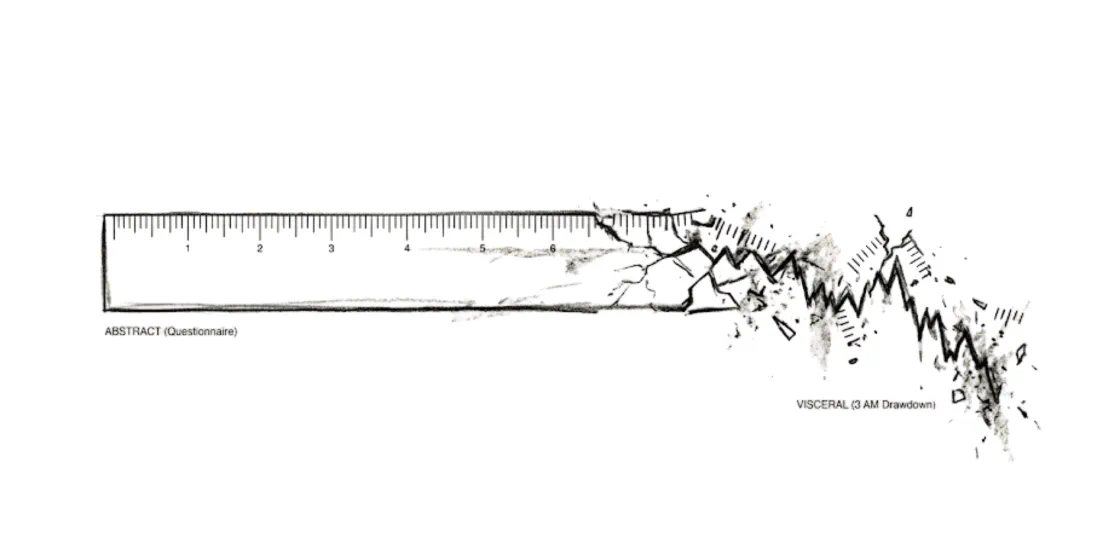
The risk-tolerance questionnaire is astrology with a compliance department attached.
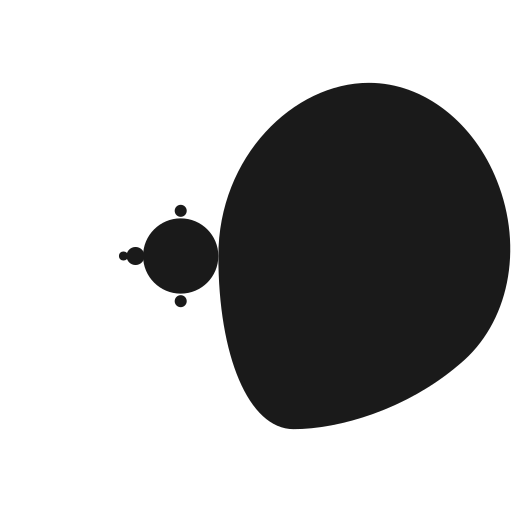
What interests me is not that the answers change, but that both answers are honest. The measurement is real. It is the ruler that keeps changing length. I wrote about this in Diligence and Allocating Attention Across a Living Surface — Spain measures its border with Portugal at 987 kilometres and Portugal measures the same border at 1,214, and neither is wrong, because the answer depends entirely on how fine your instrument is. Coarse ruler, short border. Fine ruler, long border.
Your tolerance for loss works the same way. In a calm market you measure it with a coarse instrument: a number on a page, an abstraction, twenty percent of a figure you check monthly. In a drawdown the instrument gets very fine indeed. You measure it in the hour you wake at three in the morning, in the conversation you avoid having with your spouse, in the position you sell not because the thesis broke but because you wanted the noise to stop.
The only useful risk tolerance is the one measured with the fine instrument. Which means you cannot know it in advance, only recall it afterwards, which is why the second time through a crash is different from the first.